


Problem
The contract is clear. But what happens between the contract and the invoice?
The contract defines what needs to be done. Financial systems record what was invoiced. In between lies the whole world of execution: quantities, hours, documents, photos, changes, corrections and approvals — and this is where both your own teams and your subcontractors work.
Contract
What needs to be done
Execution gap
Data scattered across tools and people
- Excel
- Paper
- Photos
- Partners
- Teams
COLLECT → CHECK → RE-ENTER → RECONCILE → REPORT

Verified realization
The basis for invoicing, reporting and decisions
The problem isn't that the data doesn't exist.The problem is that it's scattered.
Status is reconstructed from spreadsheets, e-mails, PDFs, photos and conversations, and different executors keep different records. By the time the data reaches management or finance, reality has already moved on.
Why now: a growing share of the work is done by someone outside. Subcontractors are the norm, yet the tools have stayed internal.
You're not missing data.
You're missing a reliable path from execution to information for management and invoicing.
Solution
Reported
“We did 100”
Verified
“95 verified”
Between reported and verified work there is a real business process: review, evidence, comments, corrections, responsibilities and decisions. That is the process CXM digitalizes — and verified execution then flows automatically into invoicing and payment tracking.
How it works
From execution to verified realization in three steps
- 1
Executor · own team or subcontractor
Records and reports execution
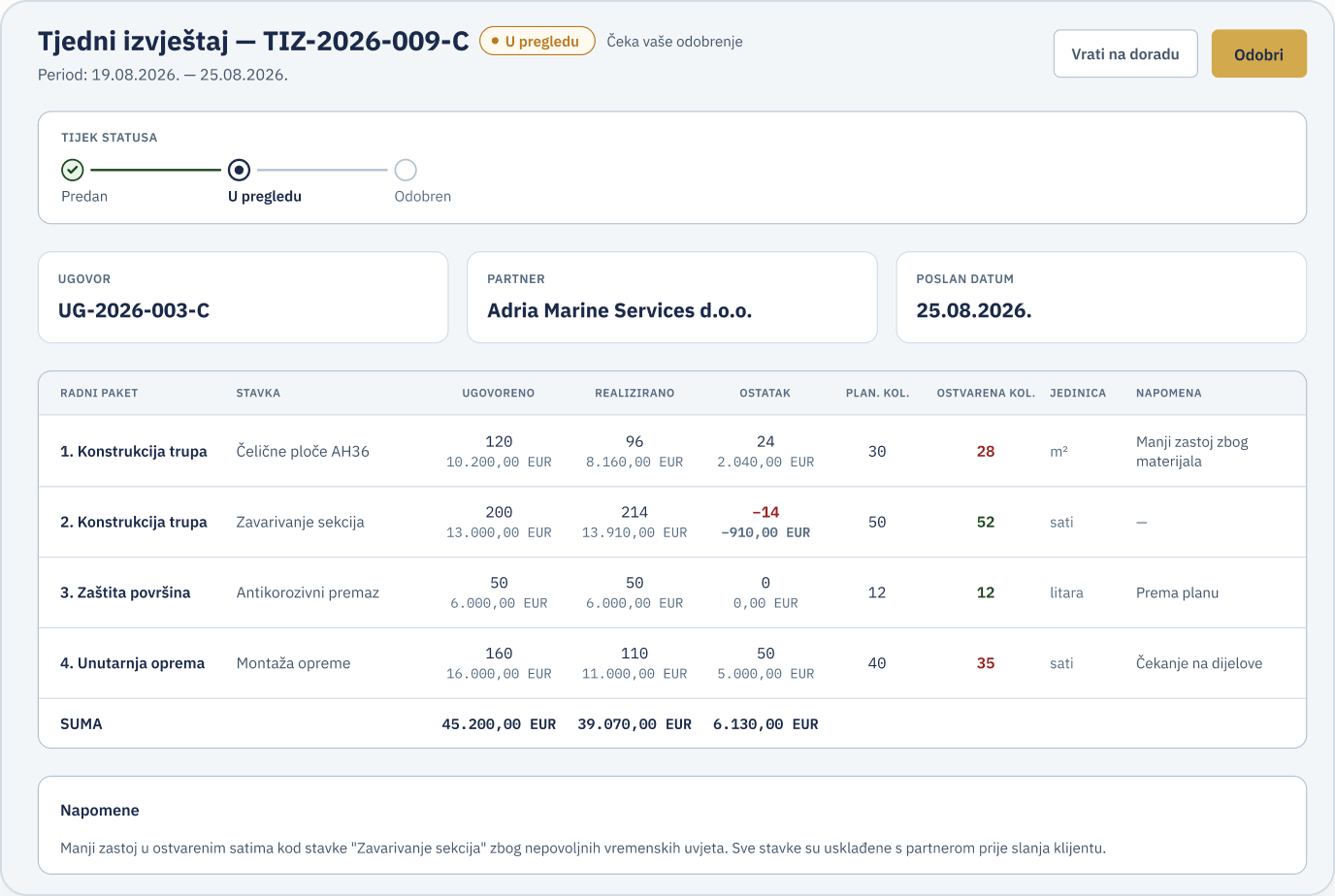
The on-board team records quantities and hours against the part of the work, with documents and photos. The contractor's lead reports the execution to the shipyard.
- 2
Shipyard's responsible person
Reviews and verifies
Reported work arrives structured: it can be reviewed, commented on, returned for correction or verified. The contractor sees returned items immediately.
- 3
Management board · management
Uses the same verified data
In detail · steps 1 and 2

 Entry from the shipmobile
In detail · step 3 · What management sees
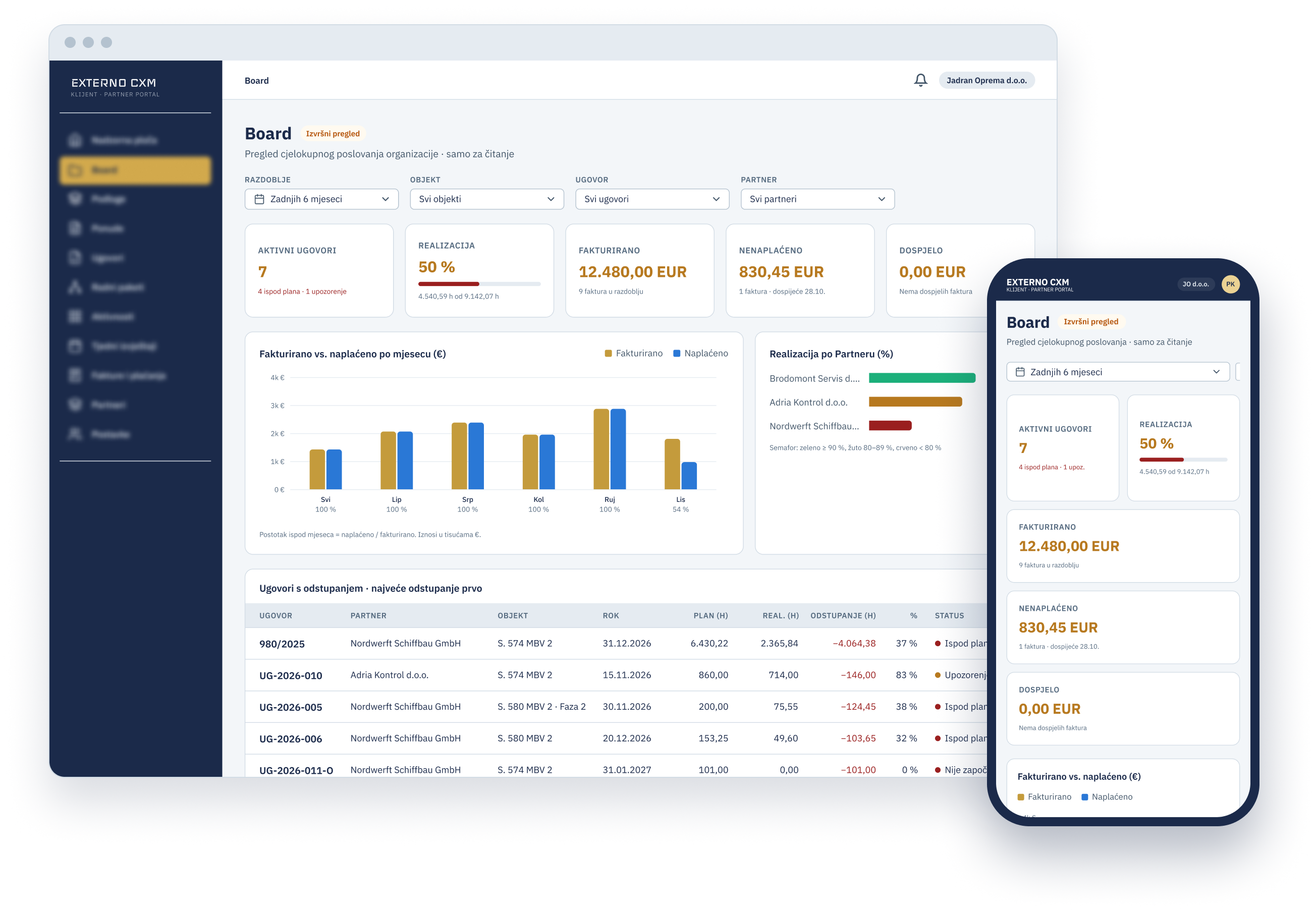
Where are we?
Plan and verified realization — from a work package to the entire newbuild.
Who is executing?
Own teams and subcontractors in the same view.
Where are we deviating?
Early insight into deviations from the contract and the plan.
What is awaiting a decision?
Reports under verification, returned items, scope changes.
What is ready for invoicing?
Verified execution as the basis for billing.
Results
What changes when execution is connected and verified?
- 01
Execution control
Every piece of execution goes through reporting and verification — for own teams and subcontractors alike.
- 02
Spot deviations earlier
Problems become visible during execution, not in next month's report.
- 03
Less administration
Less collecting, re-typing, checking and reconciling of data.
- 04
A more reliable basis for billing
From verified execution, CXM prepares and issues invoices and tracks payment. Bookkeeping stays in your ERP.
Calculate now
How many working hours could you save?
On tracking, record-keeping, reconciliation, verification and preparing data for billing.
10 people × 10 h × 48 weeks = 4,800 h per year
Hour reduction scenario
Scenarios of expected hour reduction after introducing CXM. Which scenario applies to your process is measured in the pilot.
4,800 h
2,400 h
Pilot